Delayed onset muscle soreness (DOMS) is the stiffness and discomfort you feel 24 to 72 hours after intense or unfamiliar exercise. Research …

Short on time? Here’s our summary
Delayed onset muscle soreness (DOMS) is the stiffness and discomfort you feel 24 to 72 hours after intense or unfamiliar exercise. Research consistently shows that sports massage for DOMS is one of the most effective ways to support recovery and reduce DOMS.
A 2018 meta-analysis of 99 studies found massage to be the most powerful technique for reducing both muscle soreness and perceived fatigue after exercise. A separate systematic review found that massage significantly reduced soreness at 24, 48, and 72 hours post-exercise, while also improving muscle strength and function.
At Centred, we offer sports massage for DOMS in Hull designed to help you recover faster and train more consistently. This article explains what DOMS actually is, why it happens, what the research says about massage for recovery, and how to get the most from your sessions.
That familiar ache after a hard session
You know the feeling. You pushed hard in the gym, went for a longer run than usual, or tried a new class. At the time, you felt fine. Maybe even great. But then, a day or two later, you can barely walk down the stairs.
This is delayed onset muscle soreness, or DOMS. It affects everyone from elite athletes to weekend runners, from boxers to casual gym-goers. And while it is a normal part of training, it can be uncomfortable enough to disrupt your routine and make you dread your next session.
The good news is that DOMS is manageable. And research consistently points to sports massage for DOMS as one of the most effective ways to reduce soreness and speed up recovery.
In this article, we explain what DOMS is, why it happens, what the research says about massage for recovery, and how we can help at our Hull practice.
What is DOMS?
DOMS stands for delayed onset muscle soreness. It is the pain and stiffness you feel in your muscles after exercise, typically beginning 12 to 24 hours after your workout and peaking between 24 and 72 hours. The soreness usually subsides within five to seven days.
Unlike the burn you feel during exercise (which is related to metabolic processes like lactate accumulation), DOMS is a delayed response. The pain tends to be a dull ache, felt most strongly when the affected muscle is stretched, contracted, or put under pressure. At rest, you might not notice it at all until you try to move.
DOMS is particularly associated with eccentric exercise: movements where your muscles lengthen under load. Think of lowering yourself slowly during a squat, running downhill, or the lowering phase of a bicep curl. These movements place high mechanical stress on muscle fibres and are the primary trigger for DOMS.
Common symptoms include muscle tenderness and stiffness, reduced range of motion, temporary loss of muscle strength, swelling in the affected area, and general discomfort during movement.
Why does DOMS happen?
For a long time, DOMS was blamed on lactic acid build-up. This theory has been largely disproven. Lactic acid clears from your muscles within an hour of exercise and cannot explain soreness that peaks two days later.
The current understanding is that DOMS results from microtrauma to muscle fibres, particularly during eccentric contractions. When you perform unfamiliar or intense exercise, the mechanical stress causes small-scale damage to the muscle structure. This triggers an inflammatory response as your body works to repair and strengthen the tissue.
The inflammatory process involves the release of various substances, including cytokines and other chemical messengers, which sensitise the nerve endings in and around the muscle. This sensitisation is what causes the characteristic tenderness and pain of DOMS.
Importantly, DOMS is not necessarily a sign of serious damage. It is a normal adaptive response. Your muscles are being challenged and, in response, they repair and strengthen. This is how you get fitter and stronger over time. However, the discomfort can be significant enough to interfere with training, which is where recovery strategies like sports massage for DOMS come in.
What activities cause DOMS?
Almost any exercise can cause DOMS if it is intense enough or unfamiliar. However, some activities are particularly likely to trigger it:
- Strength training, especially exercises with a strong eccentric component like squats, deadlifts, lunges, and bench press.
- Running, particularly downhill running or running on uneven terrain.
- Cycling, especially hill climbs or high-intensity intervals.
- Boxing and martial arts, which involve repetitive striking movements and high-intensity conditioning.
- Team sports like football, rugby, and netball involve a combination of sprinting, jumping, and changing direction.
- Weightlifting and powerlifting involve heavy loads that place significant stress on muscle tissue.
- CrossFit and functional fitness, which often combine high volume with varied movements.
- Returning to exercise after a break, when your muscles are no longer adapted to the demands.
Even experienced athletes get DOMS when they change their training, increase intensity, or try new movements. It is not a sign of being unfit. It is a sign that your body is being challenged.
What the research says about sports massage for DOMS
The evidence for massage as a recovery tool has strengthened considerably over the past decade.
Multiple systematic reviews and meta-analyses now support its effectiveness for reducing DOMS.
A 2018 meta-analysis published in Frontiers in Physiology examined 99 studies comparing different recovery techniques. The researchers found that massage was the most powerful method for reducing both DOMS and perceived fatigue after exercise. It outperformed compression garments, cold water immersion, contrast water therapy, cryotherapy, and active recovery.
A 2017 systematic review and meta-analysis, also in Frontiers in Physiology, pooled data from 11 randomised controlled trials involving 504 participants. The findings showed that massage significantly reduced muscle soreness at 24 hours, 48 hours, and 72 hours after intense exercise. Crucially, the review also found that massage improved muscle function, increasing both maximal isometric force and peak torque. Additionally, massage reduced serum creatine kinase levels, a marker of muscle damage.
A 2025 randomised controlled trial published in Frontiers in Physiology compared massage therapy with cold water immersion, vibration therapy, electrical stimulation, and static stretching. Massage therapy produced the greatest reduction in inflammatory markers at 72 hours post-exercise, outperforming all other interventions.
The mechanisms behind these effects are thought to include increased blood and lymphatic flow, which helps clear metabolic byproducts, reduced inflammation and swelling, activation of the parasympathetic nervous system, and direct mechanical effects on muscle tissue. The psychological benefits of massage, including relaxation and reduced anxiety, may also contribute to perceived recovery.
Sports massage for DOMS, how does it help?
Sports massage works on multiple levels to support recovery from DOMS.
Reducing inflammation and swelling
Research suggests that massage can reduce the inflammatory response that contributes to DOMS. A study published in Science Translational Medicine found that massage attenuated inflammatory signalling in muscles after exercise-induced damage. By supporting the body’s natural resolution of inflammation, massage may help speed up the recovery process.
Improving circulation
Massage increases local blood flow to the treated area. This enhanced circulation delivers oxygen and nutrients needed for tissue repair while helping to remove waste products that accumulate after intense exercise. Better circulation may explain why massage reduces creatine kinase levels, a marker associated with muscle damage.
Relieving muscle tension and stiffness
DOMS is characterised by muscle stiffness and reduced range of motion. Sports massage directly addresses these symptoms by working on tight muscle fibres and fascia. This can restore mobility and make movement feel easier, even while the underlying recovery process continues.
Activating the relaxation response
Massage activates the parasympathetic nervous system, shifting your body from a stressed state into rest and recovery mode. This is the same state in which tissue repair and regeneration occur most effectively. By supporting this shift, massage creates optimal conditions for recovery.
When should you get a sports massage for DOMS?
Timing matters when it comes to massage and recovery.
Immediately after exercise (within 2 hours): Research suggests that massage performed within two hours of exercise can be effective at reducing DOMS in the following days. If you have access to massage immediately after a hard session or event, this can be beneficial. We see many clients who book an appointment post-training.
During the DOMS window (24-72 hours post-exercise): Massage during the peak DOMS period can help manage symptoms and restore function. You may feel tender during the session, but the relief afterwards is often significant.
As regular maintenance: For those training consistently, regular sports massage (weekly, fortnightly or monthly) can help manage cumulative fatigue and prevent DOMS from becoming overwhelming. This approach is common among serious athletes and can help you train more consistently over time.
The best timing depends on your training schedule, budget, and individual response. We can discuss what makes sense for you during your appointment.
Supporting your recovery at home
While sports massage is one of the most effective tools for DOMS, there are other strategies you can use between sessions to support your recovery.
Light movement: Gentle activity like walking, swimming, or easy cycling can help maintain blood flow and reduce stiffness. This is sometimes called active recovery. Avoid pushing through intense exercise when DOMS is at its peak, as this can increase the risk of injury.
Sleep: Quality sleep is when much of your recovery happens. Aim for seven to nine hours per night, particularly after hard training sessions.
Hydration and nutrition: Adequate protein intake supports muscle repair. Staying hydrated helps all your body’s recovery processes function effectively.
Foam rolling: Self-myofascial release with a foam roller can provide some relief from DOMS symptoms. Research shows modest benefits, though less pronounced than professional massage.
Contrast water therapy: Alternating between warm and cold water can help reduce soreness, though the effect is smaller than massage. A simple version is finishing your shower with 30 seconds of cold water.
These strategies work alongside massage rather than replacing it. Used together, they can help you recover faster and train more consistently.
What to expect from a sports massage for DOMS
If you book a sports massage at Centred to help with DOMS, here is what you can expect:
Before the session: We will discuss your recent training, which areas are most affected, and what you are hoping to achieve. This helps us tailor the session to your specific needs.
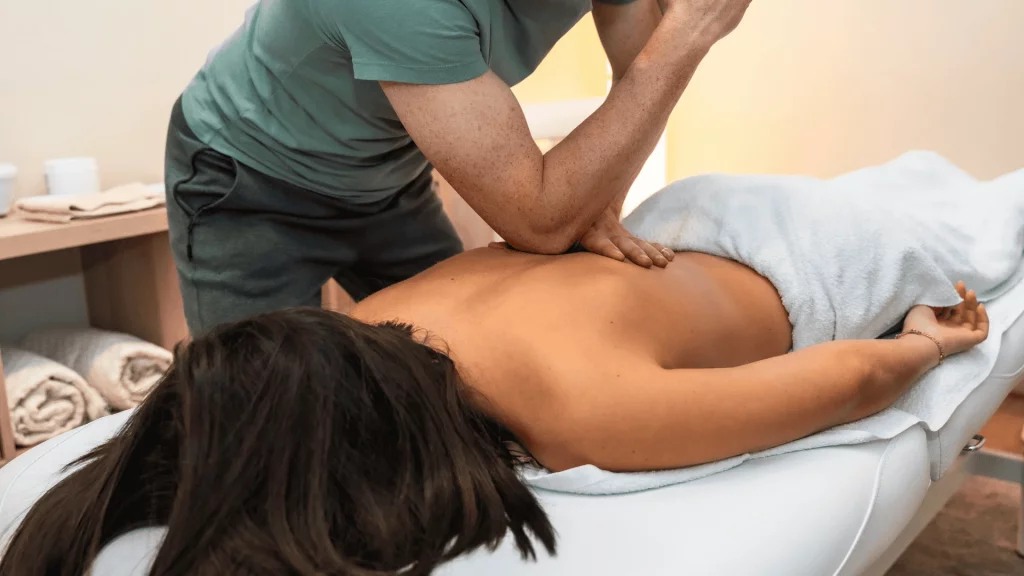
During the session: We use a combination of techniques including effleurage, petrissage, and targeted deep tissue work. When you have DOMS, the affected muscles will be tender. We adjust our pressure accordingly and check in with you throughout. The goal is effective work, not endurance.
After the session: Many people feel immediate relief from stiffness and improved range of motion. Some mild tenderness is normal in the hours following, but this typically resolves quickly. We recommend staying hydrated and avoiding intense exercise for the rest of the day.
We offer 60-minute and 90-minute sports massage sessions. For targeted work on specific areas affected by DOMS, 60 minutes is often sufficient. For full-body recovery after particularly demanding training, 90 minutes allows us to address multiple areas thoroughly.
Frequently asked questions
What is DOMS?
DOMS stands for delayed onset muscle soreness. It is the muscle pain and stiffness that develops 12 to 24 hours after exercise and peaks between 24 and 72 hours. It is caused by microtrauma to muscle fibres, particularly from eccentric (lengthening) movements, and resolves naturally within five to seven days.
Does sports massage help with DOMS?
Yes. Multiple systematic reviews and meta-analyses show that massage is one of the most effective methods for reducing DOMS. A 2018 meta-analysis of 99 studies found massage to be the most powerful technique for reducing both muscle soreness and perceived fatigue after exercise.
When is the best time to get a massage for DOMS?
Research suggests massage can be effective both immediately after exercise (within two hours) and during the DOMS window (24 to 72 hours post-exercise). For ongoing management, regular maintenance massage every one to two weeks can help prevent DOMS from accumulating.
Will the massage hurt if I already have DOMS?
The affected muscles will be tender, so you may feel some discomfort during the session. However, we adjust pressure accordingly and check in with you throughout. The goal is effective treatment, not endurance. Most people find the relief afterwards is well worth any temporary discomfort.
How long should a sports massage for DOMS be?
For targeted work on specific areas, 60 minutes is usually sufficient. For full-body recovery after demanding training, 90 minutes allows more thorough treatment.
Can I train with DOMS?
Light activity is fine and may even help reduce symptoms. However, intense training on muscles experiencing significant DOMS can increase injury risk. Most people find it helpful to train different muscle groups or reduce intensity until the worst of the soreness passes.
Is DOMS a sign of a good workout?
Not necessarily. DOMS indicates that your muscles have been challenged, but it is not a reliable measure of workout effectiveness. You can have an excellent training session without experiencing significant DOMS, especially as your body adapts to regular exercise.
What else helps with DOMS besides massage?
Other helpful strategies include light movement (active recovery), quality sleep, adequate hydration and protein intake, foam rolling, and contrast water therapy. These work alongside massage rather than replacing it.
How often should I get a sports massage if I train regularly?
This depends on your training volume and intensity. Many serious athletes have weekly or fortnightly sessions as part of their routine. For recreational exercisers, monthly sessions or treatment after particularly demanding events may be sufficient.
Where can I get sports massage for DOMS in Hull?
At Centred, we offer sports massage at our Hessle practice, just five miles from Hull city centre. We work with runners, gym-goers, boxers, weightlifters, team sport players, and anyone dealing with post-exercise soreness.
Train hard, recover well
DOMS is a normal part of training. It means you are challenging your body and giving it a reason to adapt. But managing that soreness effectively is what allows you to train consistently over time, rather than being sidelined by discomfort.
Sports massage is one of the most evidence-supported tools for DOMS recovery. It reduces soreness, improves muscle function, and helps you get back to training feeling better. Combined with good sleep, nutrition, and sensible programming, it can be a valuable part of your overall approach to fitness.
If you are in Hull or the surrounding areas and looking for sports massage to support your training, we would be glad to help.
References
Crane, J.D., Ogborn, D.I., Cupido, C., Melov, S., Hubbard, A., Bourgeois, J.M. and Tarnopolsky, M.A. (2012). Massage Therapy Attenuates Inflammatory Signaling After Exercise-Induced Muscle Damage. Science Translational Medicine, [online] 4(119). doi:10.1126/scitranslmed.3002882.
Dupuy, O., Douzi, W., Theurot, D., Bosquet, L. and Dugué, B. (2018). An Evidence-Based Approach for Choosing Post-exercise Recovery Techniques to Reduce Markers of Muscle Damage, Soreness, Fatigue, and Inflammation: A Systematic Review With Meta-Analysis. Frontiers in Physiology, [online] 9. doi:10.3389/fphys.2018.00403.
Guo, J., Li, L., Gong, Y., Zhu, R., Xu, J., Zou, J. and Chen, X. (2017). Massage Alleviates Delayed Onset Muscle Soreness after Strenuous Exercise: A Systematic Review and Meta-Analysis. Frontiers in Physiology, [online] 8. doi:10.3389/fphys.2017.00747.
Hotfiel, T., Freiwald, J., Hoppe, M., Lutter, C., Forst, R., Grim, C., Bloch, W., Hüttel, M. and Heiss, R. (2018). Advances in Delayed-Onset Muscle Soreness (DOMS): Part I: Pathogenesis and Diagnostics. Sportverletzung · Sportschaden, [online] 32(04), pp.243–250. doi:10.1055/a-0753-1884.
Category: Physical Health